 For hiring teams and job seekers
See how people think, not just what their CV says
Employers get a shortlist of applicants ranked by fit for the role. Professionals and students get their intelligence spectrum and the careers it matches. Both from a few questions answered in their own words.
One method, two ways to use it
Pick your side. Both are free while we're in beta.
Shortlist the people who fit
- ✓Describe the role. We work out which of the eight intelligences it needs.
- ✓Share one application link. Applicants answer four open questions.
- ✓Get applicants ranked by fit, with strengths, gaps and what to ask.
- ✓Go from 200 applications to the 20 worth a call. You interview and decide.
See what you could become
- ✓Build a profile with your experience, education and skills.
- ✓Answer four questions about you, one at a time.
- ✓See your intelligence spectrum and 894 careers placed by match.
- ✓You choose what's public. Your written answers stay private.
How hiring works
Three steps from job post to shortlist.
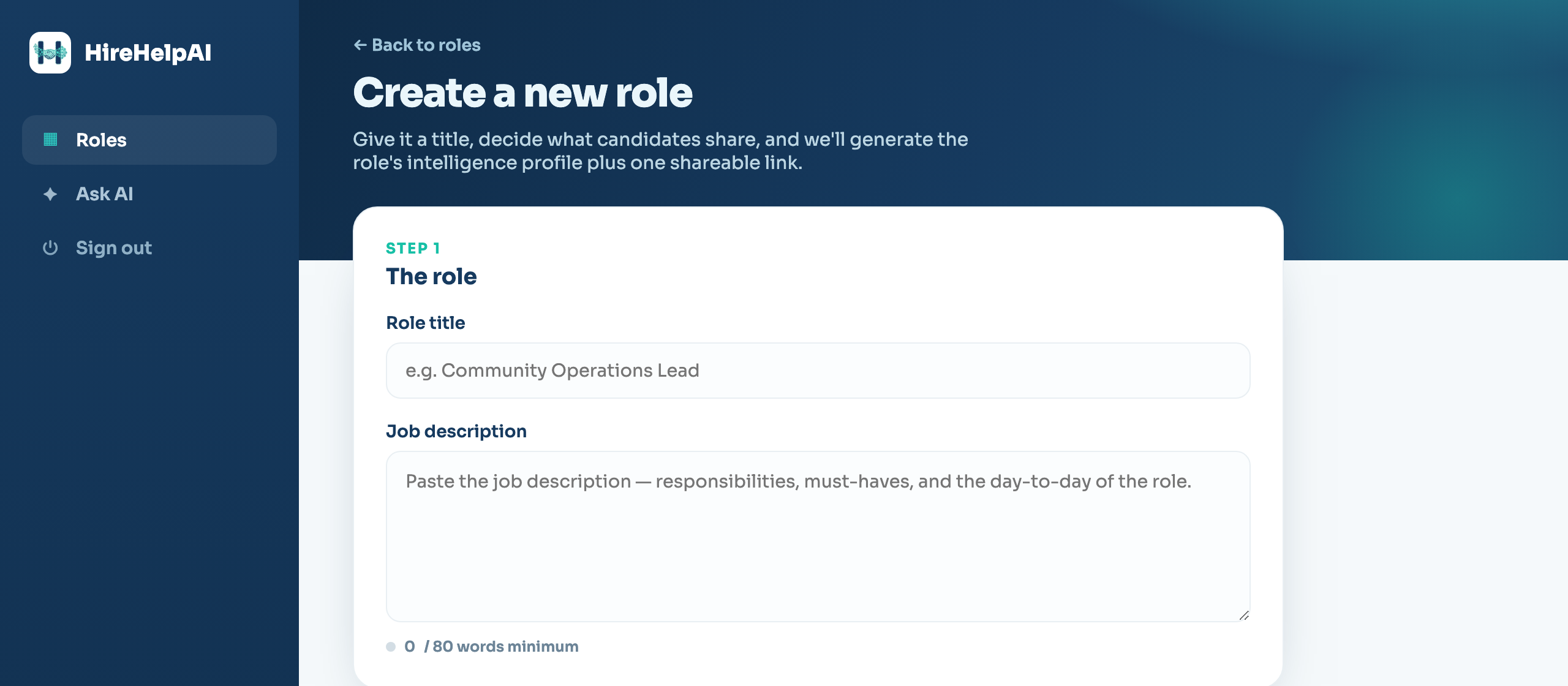
Describe the role
Paste the job description and add any fields you need: text, number, link or file upload. You get one link to share.
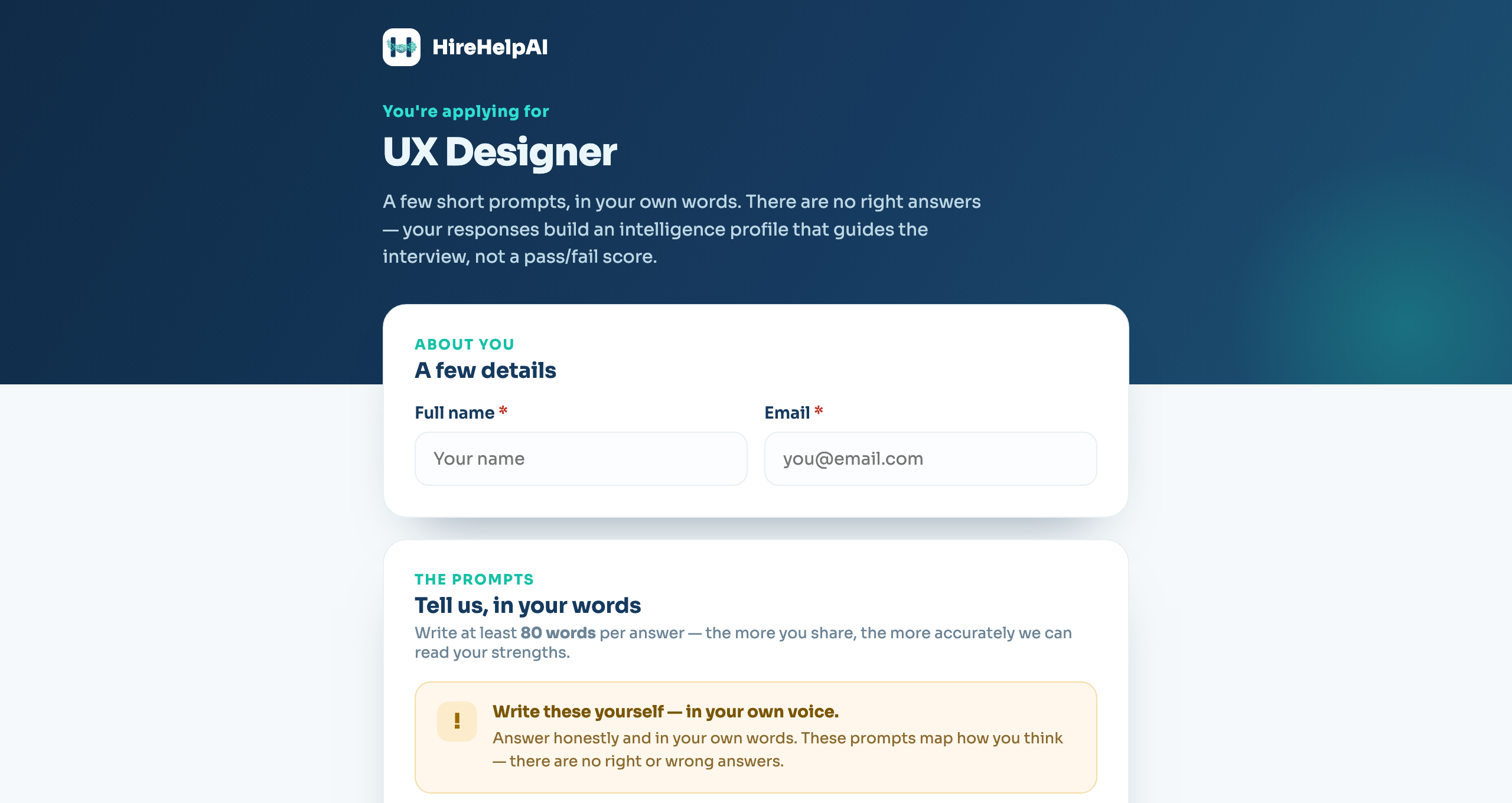
Share one link
Post it on LinkedIn or send it to applicants. They answer four open questions in their own words.
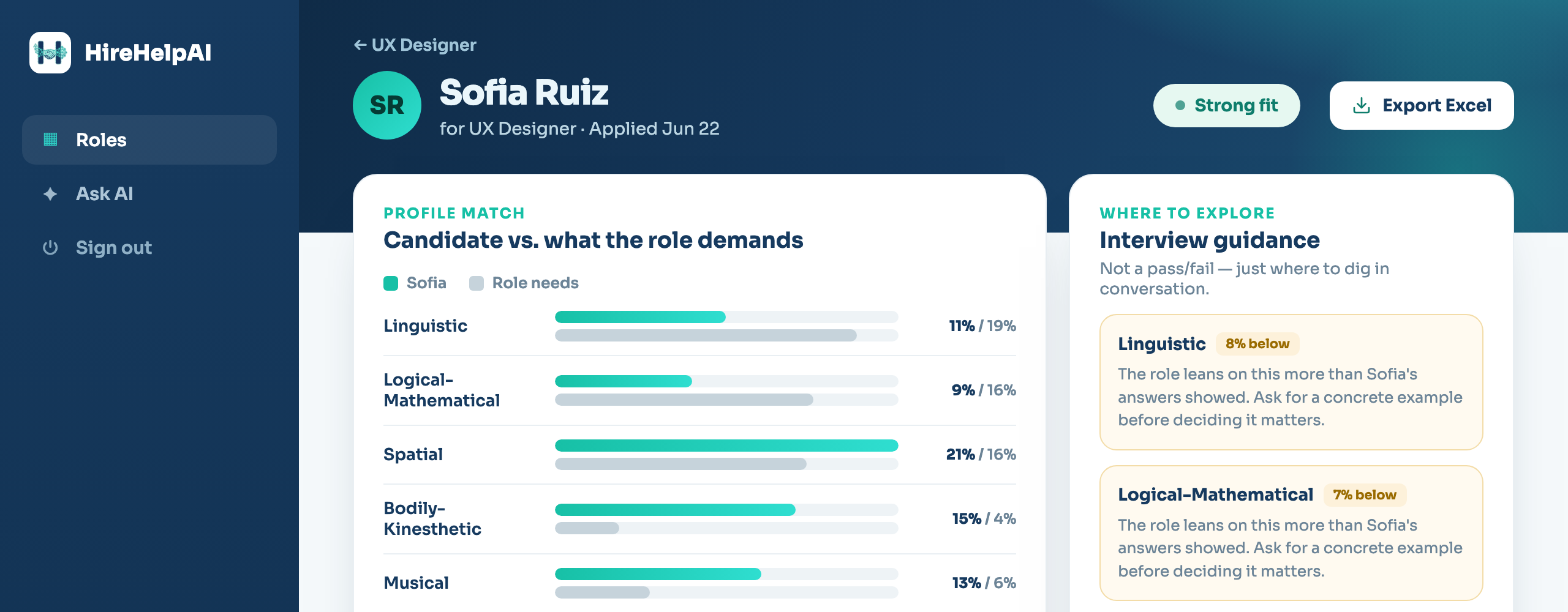
Get your shortlist
Every applicant read and ranked by fit, with strengths, gaps and what to ask in the interview.
Why eight intelligences
Most tests hand people four options or a 1–5 scale and sort them into a type. We ask open questions about you and read how you actually think.
Open answers, not ticked boxes
With four options or a rating scale, the "right" answer is easy to spot. Open questions with no right answer leave nothing to guess.
A spectrum, not a type
MBTI, DISC and similar tests put people in a box. You get a score on each of eight intelligences instead of a label.
What you've built, not today's mood
Answers draw on knowledge and experience gathered over years, not on how you happen to feel on the day.
Built for more than desk jobs
In our O*NET mapping, 694 of 894 occupations lean hardest on something other than language or logic.
For employers: the shortlist, with the reasons
HireHelp AI reads every application so you spend your time on the few who fit. You still make every call.
Turn any job description into a role profile
Paste the JD and HireHelp AI works out how the role needs someone to think, before a single person applies.
- ✓Breaks every role down into eight intelligences, not vague keywords.
- ✓Built on Howard Gardner's theory of multiple intelligences, winner of the 1990 Grawemeyer Award in Education.
- ✓Grounded in O*NET, the occupational database of the U.S. Department of Labor.
See how each applicant thinks
Applicants answer four open questions in their own words. We compare their profile with the role and show our working.
- ✓Ranked by fit for the role, so the strongest matches come first.
- ✓Where they're strong and where they fall short, with the answers behind it. No black box.
- ✓Open answers with no right answer are much harder to game than a résumé or a multiple-choice quiz.
Ask AI about all your applicants
Ask questions across every application for a role. Answers come only from what applicants wrote, and it never gives a hire or reject verdict.
- ✓One chat across the whole pool of applications.
- ✓Switch between roles so applicants never get mixed up.
- ✓Past conversations are saved so you can pick up where you left off.
For professionals: show how you think
Build a free profile, answer four questions about you, and see your intelligence spectrum and the careers that match it.
A profile that shows more than a CV
Your experience, education and skills, like any professional profile, plus the one thing a CV can't show: how your mind works.
- ✓Four questions, one at a time, and you pick each one from two: which ministry you would run, how you would spend a free day, what club you would start. A new set every time.
- ✓Your intelligence spectrum across all eight intelligences. No personality type, no box, no label.
- ✓What you could become: every one of 894 occupations placed by how closely it matches you.
- ✓You choose what's public. Your written answers are never shown to anyone.
Common questions
For employers and professionals alike.
What is HireHelp AI?
HireHelp AI is a hiring platform with two sides. Employers share one application link per role, applicants answer four open questions in their own words, and HireHelp AI reads every answer and ranks applicants by fit so you know who to interview. Professionals and students build a free profile, answer four questions and see their intelligence spectrum and the careers that match it.
How does HireHelp AI shortlist candidates?
You describe the role and HireHelp AI works out which of the eight intelligences it needs most. Each applicant answers four open questions, picking each one from two, and the AI builds their profile from those answers and compares it with the role. You get applicants ranked by fit, with where each one is strong, where they fall short and what to ask in the interview.
Does HireHelp AI make the hiring decision?
No. HireHelp AI shortlists, for example from 200 applications down to the 20 worth a call. Your team calls them, interviews them and makes every decision.
What is the theory of multiple intelligences?
It is a theory from psychologist Howard Gardner, first published in 1983, which says people have several distinct kinds of intelligence rather than one general ability. HireHelp AI uses eight: linguistic, logical-mathematical, spatial, bodily-kinesthetic, musical, interpersonal, intrapersonal and naturalistic.
How is this different from MBTI, DISC or other personality tests?
Those tests give you four options or a 1 to 5 scale, which makes the expected answer easy to guess, and many of them sort you into a type. HireHelp AI asks open questions about you, like how you would spend a free day or what you would change as a minister, and reads the answers for eight intelligences. You get a spectrum instead of a label, drawn from what you know and have done rather than how you feel on the day.
Which roles does HireHelp AI work best for?
Roles that need more than language and logic: creative, hands-on and people-facing work such as chefs, set designers, physiotherapists, landscape architects, sound engineers and event managers. In our mapping of O*NET, 694 of 894 occupations lean hardest on an intelligence other than language or logic.
I'm looking for work. Can I use HireHelp AI?
Yes, and it's free. Choose "I want to be hired" when you sign up, add your experience, education and skills, then answer four questions one at a time. You get your intelligence spectrum and all 894 occupations placed by how closely they match you.
Who can see my profile?
Your professional details and intelligence spectrum are public. Your contact details and career matches stay private unless you switch them on. Your written answers are never shown to anyone.
Can I add my own fields to the application?
Yes. Add short text, long text, number, link or file upload fields, such as a résumé in PDF, DOC, DOCX or TXT.
Is HireHelp AI free?
Yes, it's free during the beta with no credit card. Any email works: sign up and confirm it with a 6-digit code.
Ready when you are
Free while in beta. Pick your side and get started in minutes.